This is the second post in the Honswer editorial series. The first post, The honest answer to AI noise, introduced Honswer.ai and the thinking behind the firm. This post introduces the core framework: the three intelligence layers that separate a working system from a demo.
The promise versus the reality
The pitch is always the same. Plug in an AI tool, connect it to a document repository, and watch productivity climb by 40%. The vendor demo looks convincing. The pilot impresses the partners. Then the tool goes live across the practice, and the problems start.
A junior associate at a mid-size litigation firm drafts a client memo using an AI summarization tool. The output is fluent, well-structured, and cites three precedents that do not exist. Nobody catches it before the memo leaves the office. The managing partner learns about the error from opposing counsel.
This is not a hypothetical. Variations of this story have surfaced at firms across the country since 2023, most notably in the widely reported Mata v. Avianca case. The common thread is not that the AI was incompetent. The models are remarkably capable. The problem is that the AI operated in isolation: no verification layer, no deterministic checks, no structured handoff to a human reviewer before output reached the client.
A tool that generates text is not a system. A system has inputs, processing stages, checkpoints, outputs, and an audit trail. Remove any one of those components and what remains is a convenience feature with uncontrolled risk.
Why AI projects fail at professional firms
The failure pattern is consistent enough to be predictable. A practice invests in an AI tool, typically a chatbot layered over internal documents or a generative drafting assistant. The tool works well in controlled conditions. Then it encounters the edge cases that define professional work: ambiguous facts, jurisdiction-specific rules, client-specific preferences, ethical constraints.
The tool has no mechanism to handle these. It was never designed to. Generative AI excels at pattern recognition, summarization, and drafting. It is not built for applying deterministic rules, enforcing compliance boundaries, or knowing when to stop and escalate.
The same pattern plays out across liberal professions. Most “AI for lawyers” products are a language model with a retrieval layer. “AI for accountants” is typically a chatbot over tax code. “AI-assisted clinical documentation” drafts notes but has no mechanism to enforce coding accuracy or HIPAA boundaries. In each case, the architecture solves one problem (making information accessible in natural language) while leaving every other operational requirement unaddressed. Compliance checking, conflict screening, privilege protection, version control, audit logging: none of these are generative tasks. They require programmatic logic that executes the same way every time, without deviation.
The gap between “useful AI feature” and “production-grade system” is where most implementations stall. The numbers tell the story clearly: nearly seven in ten legal professionals now use generative AI individually, a figure that more than doubled in a single year according to the 2026 Legal Industry Report. But firm-level deployment tells a different story. Only 26% of firms and in-house teams have moved to active use, and fewer still have integrated AI into production workflows with the governance and automation those workflows require. The pattern is consistent: individual experimentation surges ahead while institutional adoption stalls at the point where a tool needs to become a system.
Practices that recognize this gap early can avoid the expensive cycle of pilot, disappointment, and abandonment that has become the default experience.
The orchestra metaphor, and why it holds up
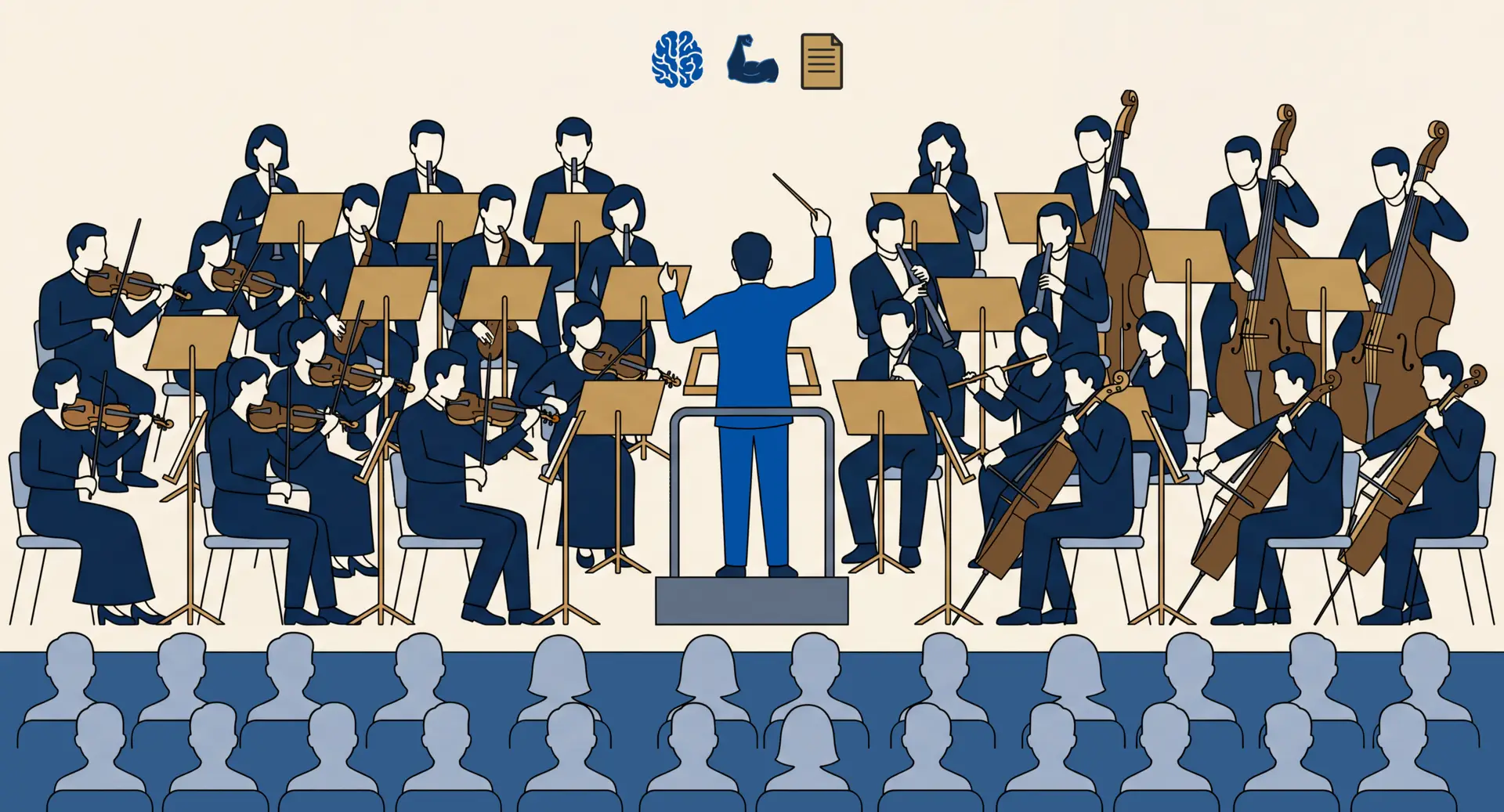
Consider a professional orchestra. The musicians are extraordinarily talented. They can sight-read complex scores, improvise, and adapt in real time. But no one expects an orchestra to perform without a score or a conductor. The score provides the deterministic structure: which notes, in which order, at which tempo. The conductor provides human judgment: interpretation, pacing, emphasis, the decision to adjust when something is not working.
An orchestra without a score drifts into improvisation: interesting, perhaps, but not repeatable and not auditable. An orchestra without a conductor plays competently but without coherence. Only with all three (talent, structure, and judgment) does the performance become reliable enough to stake a practice on.
AI in a professional practice operates on the same principle. The AI layer is the ensemble: capable, fast, productive. Programmatic automation is the score: deterministic, consistent, auditable. Human intelligence is the conductor: strategic, ethical, and responsible for the final output.
This is the foundation of what Honswer calls the three intelligence layers, introduced in the first post in this series and examined in detail here.
The three intelligence layers, examined concretely
Abstract frameworks are simple to agree with and hard to act on. The value of the three-layer model becomes clear when applied to the workflows that define professional practice. Three examples illustrate the pattern across different disciplines.
Conflict-of-interest screening in law
Without a system, a new client inquiry arrives by email and a paralegal searches the firm’s contact database manually. If the search returns nothing obvious, the matter proceeds to engagement. The process depends on the paralegal’s thoroughness and whether anyone remembers a prior relationship that was never formally recorded. When it fails, the consequences are severe: disqualification, malpractice exposure, regulatory sanction.
With a three-layer system, programmatic intelligence triggers a structured search across the CRM, document management system, email archives, and billing records the moment an inquiry is logged. Every search is recorded with a timestamp and result set. Artificial intelligence then analyzes the flagged results in context: Does the entity name match exactly, or is it a subsidiary? Is the prior matter related, or is the overlap incidental? The AI summarizes the potential conflict and drafts a preliminary assessment. Human intelligence closes the loop. A senior attorney reviews the assessment, weighs the ethical nuances and relationship dynamics, and makes the determination: proceed or decline. The decision is documented and the audit trail is complete.
Patient intake and triage in medicine
Without a system, a front-desk coordinator takes a phone call, enters patient information into the EHR, and decides whether the appointment is urgent based on a brief verbal description. Insurance eligibility is checked manually, sometimes after the appointment has already been scheduled. Errors in coding or eligibility create denied claims, delayed treatment, and compliance exposure under HIPAA.
With a three-layer system, programmatic intelligence captures the intake data through a structured form, validates insurance eligibility in real time against the payer database, and applies triage rules (symptom keywords, patient history flags, scheduling constraints) to assign a preliminary urgency level. Artificial intelligence reviews the patient’s stated symptoms alongside their medical history, identifies patterns that may warrant escalation (for example, a combination of symptoms that individually seem routine but together suggest something more acute), and generates a triage summary for the clinician. Human intelligence makes the clinical call. The physician reviews the AI summary, applies medical judgment, and decides on the care pathway. No algorithm replaces the clinician’s assessment of whether a patient needs to be seen today or next week.
Month-end close in accounting
Without a system, the close process is a spreadsheet-driven relay race. Staff accountants pull data from multiple sources, reconcile accounts manually, and flag discrepancies in emails. The review partner works through a stack of workpapers, often finding errors that require re-pulling data and restarting the reconciliation. The process takes days longer than it should, and every month the same mistakes recur.
With a three-layer system, programmatic intelligence handles the extraction and reconciliation. Automation pulls trial balances from the general ledger, matches intercompany transactions, applies standard adjusting entries, and flags any variance that exceeds defined thresholds. Every step is logged. Artificial intelligence analyzes the flagged variances: Is this a timing difference that will self-correct, or an actual discrepancy that requires investigation? The AI cross-references prior-period patterns and drafts explanatory notes for the review partner. Human intelligence provides the professional judgment. The CPA reviews the flagged items, evaluates materiality, and signs off on the close. The professional’s signature carries legal weight that no automation can replicate.
The pattern across all three
In each case, removing any layer degrades the system. Programmatic automation without AI still requires a human to review every flagged item manually, negating most of the efficiency gain. AI without programmatic rules has no reliable trigger, no audit trail, and no guarantee of completeness. Human judgment without either layer remains the status quo: slow, expensive, and dependent on individual diligence.
What “system” actually means
The word “system” has a specific meaning in engineering that gets diluted in marketing. A system is a set of components that interact to achieve a defined outcome, with clear boundaries and observable behavior. For a professional practice, a production system has five non-negotiable characteristics:
- Defined inputs. The system knows what triggers it and what data it requires. A conflict check begins with a structured inquiry form, not a forwarded email with “can you look into this?”
- Processing stages. Each stage has a specific function, a defined output, and a clear handoff to the next stage. The programmatic search produces a result set. The AI analysis produces a summary. The human review produces a decision.
- Checkpoints. At every stage, the system can pause, escalate, or reject. A conflict check that finds ambiguous results does not silently proceed. It flags and waits.
- Outputs. The final output is documented, versioned, and attributable. An engagement letter is not a draft in someone’s inbox. It is a controlled document with a clear chain of custody.
- Audit trail. Every action is logged. Every decision is traceable. When a regulator or malpractice insurer asks “how did this happen,” the answer is retrievable, not reconstructed from memory.
If any of these characteristics is missing, the practice has a tool. It does not have a system. The distinction is not academic. It is the difference between a competitive advantage and an unmanaged liability.
The path forward
None of this requires a massive technology overhaul. The three-layer model is a design principle, not a product. It can be applied incrementally, starting with the workflows that carry the most risk or consume the most non-billable time.
The practical starting point is an honest inventory. Every practice has a handful of workflows that are simultaneously high-risk and high-frequency: conflict checks, client intake, document review, regulatory filings, billing reconciliation. These are the workflows where the cost of failure is measurable and the cost of manual execution is visible on every timesheet. Starting with one of these, mapping its current state, and redesigning it as a three-layer system produces results that justify the next iteration.
The critical shift is not technological. It is architectural. The question is not “which AI tool should the practice buy?” but rather “what does a complete system look like for this workflow, and which intelligence handles each stage?” That reframing changes the evaluation criteria entirely. A vendor that offers an AI drafting assistant is solving one-third of the problem. The remaining two-thirds (deterministic automation and structured human oversight) still need to be designed.
The next post in this series introduces a practical decision framework: how to evaluate any task in a practice and determine which intelligence layer, or combination of layers, should handle it. That framework turns the abstract model described here into a working tool for operational decisions.
AI is not the problem. Isolation is the problem. When artificial intelligence operates within a coordinated system, bounded by deterministic rules and governed by human judgment, it becomes what the vendors promised all along: a genuine revolution.